
Most players sit down, buy a card, and hope for luck. That is the wrong approach. 90 ball bingo is a structured game with real mechanics, real probabilities, and real money on the line. We have watched too many players lose consistently because they never bothered to understand what they were actually playing. This post fixes that.
Why 90 Ball Bingo Deserves Your Serious Attention
Let us be direct. Many players stumble into bingo rooms without a framework. A quality platform, such as Casino Zoome Australia, operates as a high-tier platform built to reward informed players, not passive ones. It is one of the best instruments for making money when you know the rules cold. 90 ball bingo is the format where knowing the structure separates winners from tourists.
The game uses 90 numbered balls. That range, 1 through 90, creates a specific probability environment. Every ball drawn shifts the odds. Every card you hold is a position in that probability field. Stop treating it like a raffle. Start treating it like a discipline.
The Anatomy of a 90 Ball Ticket
The ticket structure is not random. It is engineered. Understanding it is step one toward playing with purpose.
How the Ticket Is Built
Every 90 ball ticket follows a strict grid layout. Here is exactly how it breaks down:
1. Step 1: Count the columns. Each ticket has 9 columns. Column 1 holds numbers 1-9, column 2 holds 10-19, and so on through column 9 which holds 80-90.
2. Step 2: Count the rows. Each ticket has exactly 3 rows. No exceptions.
3. Step 3: Count the numbers. Only 15 numbers appear on any single ticket. The remaining 12 spaces per row are blank.
4. Step 4: Locate the spread. Each row contains exactly 5 numbers and 4 blank spaces. This distribution is fixed by design.
5. Step 5: Understand the strip. Six tickets form one strip. A full strip covers all 90 numbers exactly once. That matters for card management strategy.
The Three Winning Categories: Know Them Cold
90 ball bingo does not have one prize. It has three distinct win conditions, played in sequence within a single game. Each one rewards a different type of attention.
One Line, Two Lines, Full House
The first win goes to the player who completes any single horizontal row on their ticket. Five numbers. That is all. Fast, frequent, and low-value in most prize pools. The second win requires completing any two rows on the same ticket. This is the mid-game checkpoint. The third win, the full house, requires all 15 numbers on a single ticket to be called. This is the main prize. This is what the game is built toward.
Do not ignore the one-line prize because you are chasing the full house. Early wins are cash in hand. Take them.
90 Ball vs. 75 Ball: The Comparison That Actually Matters
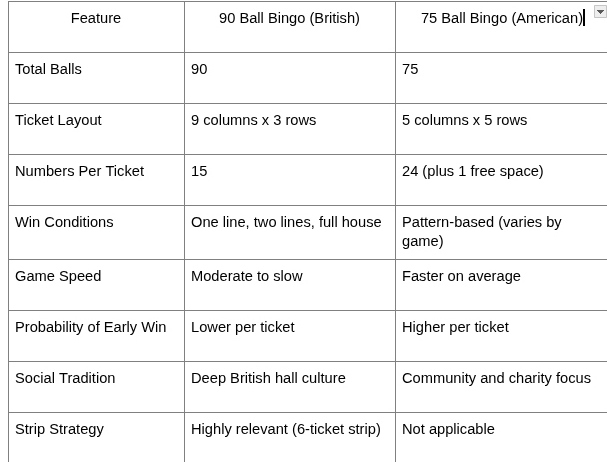
Players switching between formats make costly errors. They apply the wrong mental model. Here is the side-by-side breakdown so you stop confusing the two.
Study this table before you sit down at any bingo room:
The Caller, the Draw, and the Social Layer
In live halls, the caller is the engine of the game. They draw each ball, announce the number, often with traditional British nicknames attached. Two fat ladies for 88. Legs eleven for 11. This is not decoration. It is the social architecture that built decades of community loyalty around this format.
Online platforms replicate the draw with random number generators. The social layer survives through chat functions. Do not dismiss the community aspect. Players who engage tend to stay longer, play smarter, and enjoy better mental discipline at the card. Isolation breeds poor decisions.
Bankroll and Card Management: The Part Most Players Skip
Buying more cards feels like buying more chances. It is, technically. But unmanaged card volume destroys focus. You miss numbers. You miss wins. Here is the governing principle: buy only as many cards as you can actively track without losing accuracy.
Pro Tip: When playing a strip of six tickets, you have complete coverage of all 90 numbers. Every ball called marks something on your strip. This is statistically cleaner than buying random individual cards. Start with one full strip. Track every number. Only expand your card count once you can handle one strip without errors. Discipline first. Volume second.
Probability Is Not Luck: Read the Room
As more balls are drawn, the probability of completing your remaining numbers increases. At 45 balls called, roughly half the field is marked. If your ticket still needs 10 numbers, you are behind the average pace. That is useful information. Adjust your expectations. Manage your budget accordingly. Do not chase a full house with four numbers remaining when the pot does not justify the remaining card spend.
Smart players track pace. Casual players track hope. We know which group cashes out more often.
