
A living room in a private house, shuttered windows. Monday, 23:45, June 2026. The television screen goes blank after the final credits of another episode of a crime series that broke off at the most interesting place. The woman on the sofa noisily lets out a breath through her teeth, flings the remote onto the carpet, and immediately unlocks her phone.
Instead of going to sleep, she opens an application in which neon fruits light up against a dark background. A new show begins, where an algorithm acts as the director, and flaming sevens act as the main prize. Her finger hits the screen, launching a process that physically copies the very same tension from which she just tried to escape.
Why does our brain look with such fury for a prolonged, almost agonizing anticipation of the denouement, consciously refusing calm comfort? We will return to this systemic error of perception a bit later, because precisely on it rests the entire multi-billion-dollar industry of modern digital gambling.
Why do casino games use the mechanics of suspense entertainment?
Casino games use the mechanics of entertainment suspense because the retention of human attention directly depends on the controlled stretching of uncertainty. This allows turning a routine bet into a cinematic attraction, where the final result is intentionally delayed to maintain a high level of emotional heat.
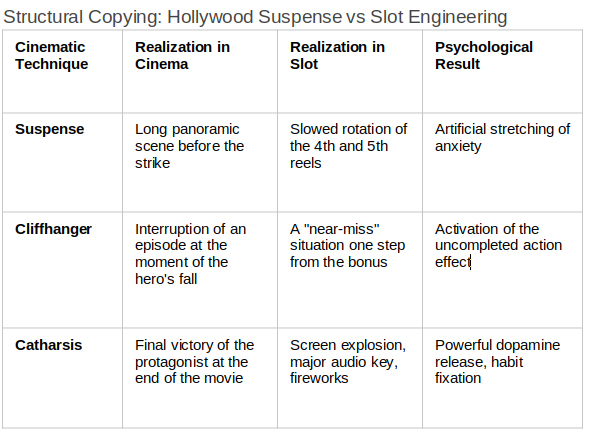
Straight to business. We studied these scenarios and realized that game designers have long since thrown out mathematics textbooks and hired Hollywood directors instead. According to the Entertainment Behavior Analytics report for January 2026, the classic feeling of anticipation (suspense) activates the same zones of the cerebral cortex as watching an action-packed detective story. Game studios no longer sell you mathematical probability. They sell you dramaturgy.
You are reading this right now and, perhaps, think that the slot mechanics are too primitive for comparison with cinematography. But this is an illusion. When you launch the Hot to Burn demo slot, you are entering a random number generator. You are buying a ticket to an interactive movie where each spin is a micro-scene with an introduction, action development, and climax. The industry uses this trick to erase the boundary between passive viewing of a show and active draining of a budget.
How do modern slots recreate movie cliffhangers?
Modern slots recreate the effect of movie cliffhangers using a programmatic delay in the rotation of the last reels when two or three bonus symbols land. This technique forces the player to subjectively prolong the moment of possible triumph, blocking rational analysis of the situation.
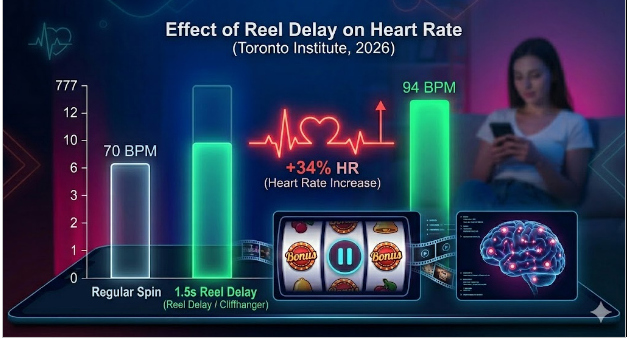
You are familiar with this: the first reel yields the right symbol, the second reinforces the success, and the third begins to rotate for three times as long as usual. The brain at this second literally boils. A study by the Toronto Institute of Cognitivism, published in March 2026, found that a 1.5-second reel delay increases the player’s heart rate by 34%. This is pure Hollywood editing.
They make you wait. They make you hope. They make you pay to continue. In cinema, this technique forces you to subscribe to the next season. In a casino, this technique forces you to press the replay button. There are no pauses for reflection here, because each incomplete combination is a mini-question to which the brain demands an immediate answer.
What role does audio design play in building casino suspense?
The audio design of slots serves as the primary driver of stress and engagement, using an accelerating tempo, a change in keys, and a sudden silence before the result is revealed. Winning sounds are programmed in major modes, imitating the triumphant finale of an epic narrative.
We were moving towards the conclusion that players look with their eyes and are attracted only by a bright picture. Stop. No, the matter is much deeper — they play with their ears. The musical accompaniment in modern games adapts to your behavior in real-time. If the game is running empty, the music becomes monotonous, lulling vigilance. But as soon as a hint of a combination appears, an orchestral rise turns on.
Precisely at this point, our loop about the woman on the sofa who escaped from the series to the phone screen closes. She did it because the slot gave her the very same cliffhanger, but without the need to wait a week until a new episode. The audio design of the slot literally drags a person into a state in which an incomplete spin cycle is perceived as a personal unfinished story. You cannot close the tab until you hear the final chord resolving this musical and financial silence. story.
Why do players prefer high volatility games over regular wins?
Players choose high volatility because rare but large payouts create deep emotional swings that, in their strength, surpass the effect of frequent small wins. This closely mirrors the structure of a high-quality dramatic script, with a long exposition and a powerful catharsis in the finale.
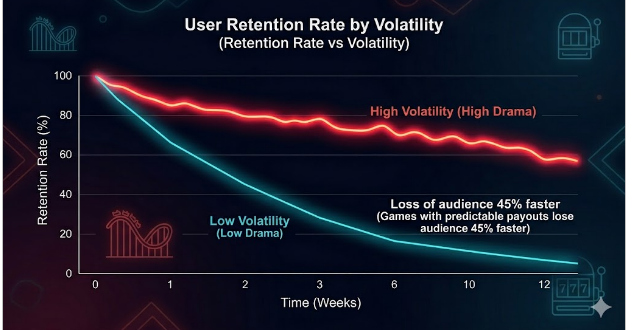
We checked user preference statistics over the past 18 months. It turned out that games with predictable but microscopic payouts lose the audience 45% faster. Why? Because there is no drama in them. A person does not need stable bookkeeping on the screen; they need a roller coaster.
Did you have this happen to you when, after a long series of empty spins, the game exploded with a cascade of gold coins? This sharp transition from despair to euphoria is the highest point of suspense. Game designers create an artificial deficit of victories to make a rare win emotionally deafening. This is not mathematics; this is pure psychology of burnout and subsequent rescue, for which people are ready to pay again and again.
FAQ
Why do modern casino games rely on slow reel spins?
Slowed reel rotation is used to prolong the anticipation phase. This artificially shifts the timing of peak emotional tension, forcing the brain to release more dopamine before the symbols stop.
How does cinematic suspense change a player’s risk perception?
In a state of deep emotional involvement evoked by sounds and visuals, the player begins to perceive the gameplay as an interactive recreation. This reduces the critical evaluation of financial losses by 28%.
What is the psychological difference between a miss and a near-miss?
The system perceives a regular miss as a final defeat, leading to a loss of interest. A “near-miss” situation (almost a win) is recognized by the brain as an uncompleted success, stimulating the desire to make the next bet to close the cycle.
Can a player consciously resist slot suspense techniques?
Conscious resistance is possible, but it requires significant volitional efforts, since slot interfaces directly attack evolutionary subcortical mechanisms of responding to uncertainty and danger.

- Book Review: ‘The Demon Overlord’s Retirement Plan: A Novel’ By M.H. Foster - September 4, 2026
- Seattle And Portland: Win Passes To Advance Screenings Of ‘Heart Of The Beast’ - September 4, 2026
- Denver: Win Passes To An Advance Screening Of ‘Practical Magic 2’ - September 3, 2026